


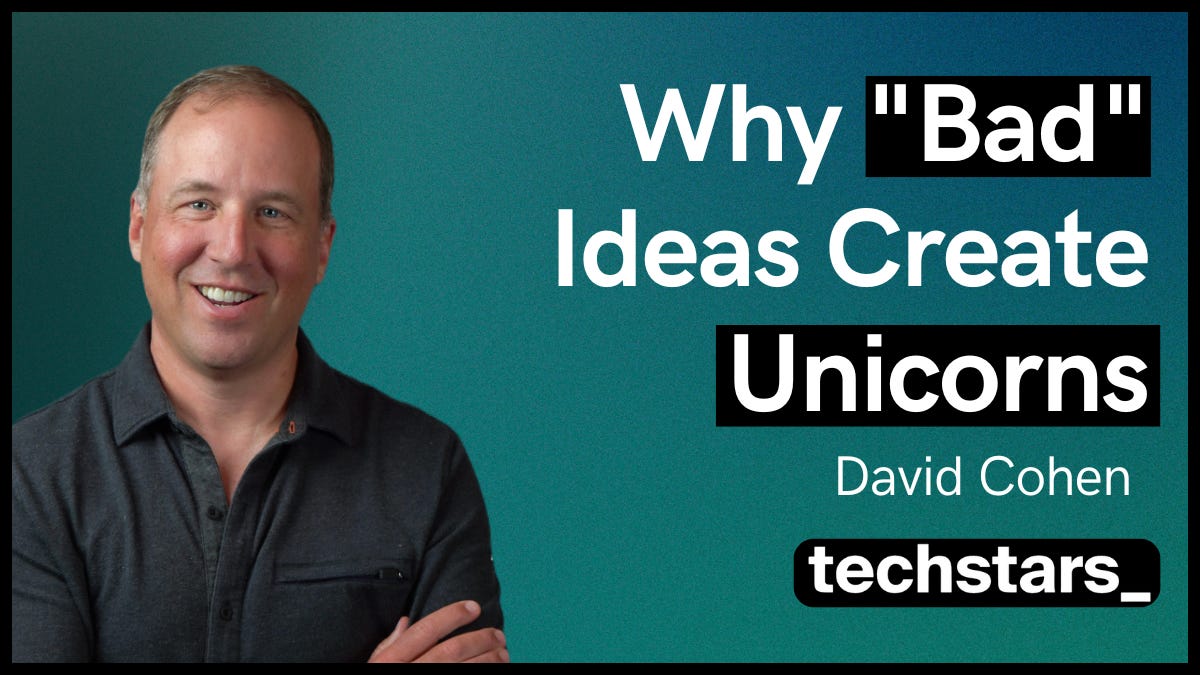
Techstars founder David Cohen was an angel investor in Uber. He also had the chance to invest in Lyft — and passed.
Same market. Same timing. Two completely different outcomes in his portfolio.
The difference? At Uber, he met Ryan Graves (employee #1) at Techstars. “I really clicked with him.” He invested without ever meeting the Uber founders.
At Lyft, Matt Van Horn was a Techstars mentor. They were friends. But the idea seemed stupid: “Intercity transport for college kids? I didn’t get it.”
That same team pivoted, fast-followed Uber, and built a multi-billion dollar company.
After 20 years evaluating startups, the pattern behind his misses is always the same.
The Miss Framework: Why “Bad Ideas” Create Unicorns
The problem: We judge founders by their initial ideas, when ideas are what change the most.
The framework: There’s a Venn diagram that explains everything: “Seems like a bad idea” vs “Actually is a good idea.” The tiny overlap in the middle is where real money is made.
Why it works:
Uber and Airbnb were “stupid ideas” — No one wanted to ride in a stranger’s car. No one wanted to sleep in a stranger’s house. Today they’re worth hundreds of billions.
The idea blinds you to the team — When an idea seems so bad, you never get to properly evaluate the people. And the right people will pivot to something that works.
The market matters more than the idea — Cohen now asks: “Do you love the market? Because they’re probably staying in that market.” The specific idea will change. The market won’t.
The tactical shift:
Before: “Is this idea good?”
Now: “Do I love this team? Am I interested in this market?”
The lesson: Great teams can fix bad ideas. Great ideas can’t fix bad teams.
“The commonality in my passes is that they were ‘bad ideas.’ And there’s a Venn diagram I always remember: what seems like a bad idea, what actually is a good idea, and that tiny overlap in the middle — that’s where people make fortunes.”
This is the simplified framework, but David goes much deeper on how AI is changing founder evaluation (spoiler: technical talent matters less, market insight matters more), why he believes we’ll soon see “zero-employee unicorns,” and his contrarian take on why you DON’T need to be in San Francisco to build a world-class company.
🎧 Listen to the full episode: → [Spotify] → [Apple Podcasts] → [YouTube]
Also in this episode:
[15:50] – Why AI creates a “barbell effect” for startups — the middle gets stuck
[26:00] – How to scale networks without destroying them — segmentation is key
[31:30] – Techstars’ internal meme: “Replace ‘AI’ with ‘software’”
[38:35] – Why AI agents will do venture capital — and probably better than humans
[40:10] – Jack Bogle’s philosophy applied to VC: “The finance industry just subtracts value from society”


